Cannabinoid observatory and product analysis
CBG in France and CBDV in Germany: what did each country authorise?
What would it take to verify a label that says “legal CBG”? For seeds of the French hemp variety Seraly 25, the answer is a dated entry in the official journal. Germany has a similarly precise record for an experimental oral solution containing a different cannabinoid, cannabidivarin. Both records identify the product, the country and the purpose covered by the decision.
Milnubes editorial desk ·
| What can be checked | Document | Scope |
|---|---|---|
| Seraly 25 seed · France | Order of 27 March 2026, Article 1 | Ten-year listing on List A of varieties whose seed may be marketed. |
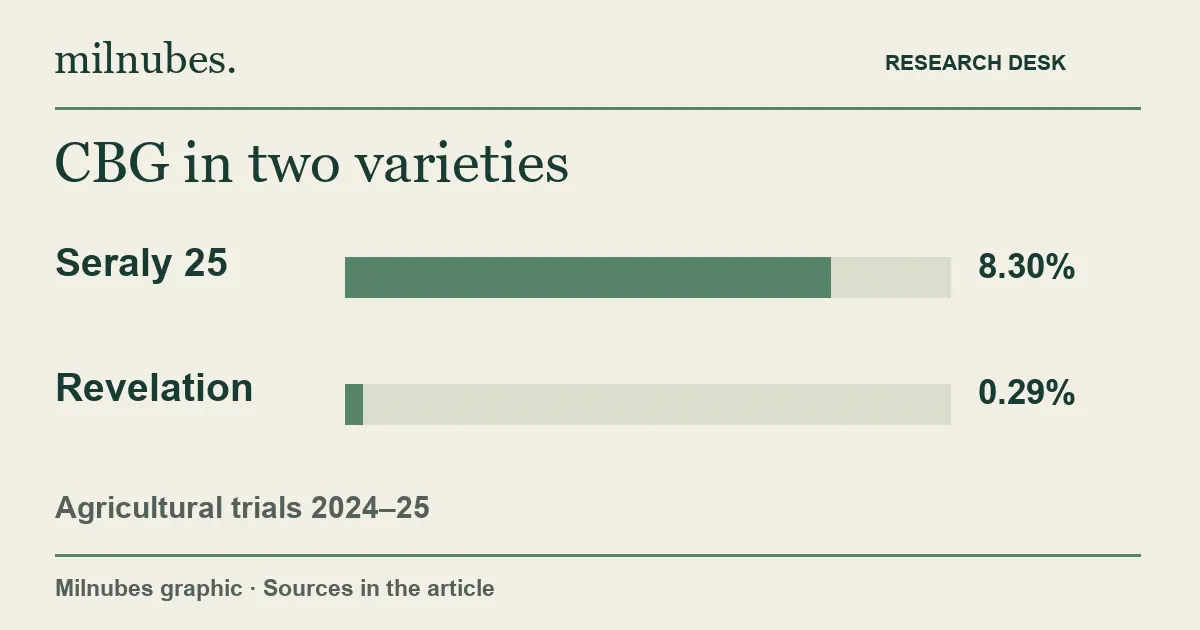
| Potential CBG in Seraly 25 · France | CTPS/GEVES, 2024 and 2025 trials, p. 8 | 8.30% in the combined trial figures. This describes the plant material evaluated. |
| CBDV oral solution · Germany | EudraCT 2014-005344-17, sections D and N | BfArM authorised the trial. The register records marketing authorisation separately. |
| CBD in e-liquids · Switzerland | Federal guide, version 8, section 5.8 | The passage names CBD. It does not establish specific permission for added CBG, CBN or CBC. |
How Seraly 25 found its way into the French seed catalogue
On 29 March 2026 the French official journal published the ten-year listing of Seraly 25 and Revelation on List A, the register of varieties whose seeds may be marketed in France. The agricultural trials explain their connection to cannabigerol. Across the 2024 and 2025 growing seasons, CTPS/GEVES reported a potential CBG content of 8.30% for Seraly 25 and 0.29% for Revelation. Those figures describe plant material tested under the trial conditions. A particular batch would need its own analysis.
Which product does the French listing cover?
Both varieties also appeared in the supplement to the EU common agricultural variety catalogue on 26 May 2026. In France, Article 1 of the order of 30 December 2021 sets conditions for hemp, including a maximum of 0.30% delta-9-THC for eligible varieties. Flower and leaf production requires certified seed and is reserved for active farmers. The catalogue entry settles a question about an agricultural variety. Whether a finished CBG cartridge could be sold in Spain would require a separate assessment under the rules for that product and destination.
Berlin's CBDV trial has a product code
On 26 May 2015 the German medicines authority BfArM authorised a phase II trial of the CBDV oral solution GWP42006. Researchers at Charité compared it with placebo in people with HIV-associated neuropathic pain. The trial ended on 15 January 2020. The investigators found no significant reduction in pain compared with placebo. The trial record also states that the investigational product lacked a marketing authorisation.
Does a statement about CBD cover CBG, CBN or CBC e-liquids?
Section 5.8 of Switzerland’s May 2025 federal guidance explicitly addresses adding CBD to e-cigarettes and refills. It describes this as generally permitted and sets out obligations for self-monitoring, notification and labelling. Cannabinol (CBN) and cannabichromene (CBC) are separate compounds. The passage does not document specific permission to add isolated CBN, CBC or CBG to a refill liquid. A Spanish retailer would also need evidence relevant to the product under Spanish rules.
Switzerland has a specific rule for pure CBN
In July 2026 Swissmedic clarified that pure CBN falls under group 303 of the Swiss controlled substances ordinance. There is an exemption for industrial or scientific use that can be substantiated, subject to the law governing the finished product. Private use remains controlled, and trade alone does not qualify as industrial use. The clarification separately addresses CBN occurring naturally in cannabis at its original concentration, without enrichment or addition.
What the European Commission decided about CBG in food
On 29 July 2024 the Commission closed two novel food applications, one for synthetic CBG (NF/2022/6330) and one for CBG from Cannabis sativa L. (NF/2022/6332). Neither decision added CBG to the Union list. EFSA’s safety statement of 9 February 2026 concerns CBD in certain food supplement formulations. It is a scientific assessment of oral intake. An authorisation to place a food on the market is a separate decision.
Sources
- France · Order of 27 March 2026, Article 1, published on 29 March
- CTPS/GEVES · Official hemp trials, March 2026 report, p. 8
- Official Journal of the EU · Common catalogue supplement, 26 May 2026, section 85 (French PDF)
- France · Consolidated legal conditions for hemp, Article 1
- EU Clinical Trials Register · German decision and investigational product
- Eibach and colleagues · CBDV trial results in HIV-associated neuropathic pain
- Swissmedic and Swiss federal authorities · May 2025 guide, section 5.8
- Swissmedic · Clarification on CBN and group 303, July 2026 (PDF)
- European Commission · Decisions terminating novel food procedures
- EFSA · Provisional safety assessment of CBD in food supplements, February 2026