Cannabinoid observatory and product analysis
CBG, CBN and CBC at CanaPuff: twelve labels, two formats
Papaya Punch turns up twice. On one listing the name belongs to a bottle of CBN liquid. On another it belongs to a device that already contains the liquid. The first gives an amount in milligrams and the second a percentage. How do you compare them? Start with the object each figure describes. Watermelon turns up in the same two formats.
Milnubes editorial desk ·
| Declared name | Format | Names in the catalogue | Stated quantity |
|---|---|---|---|
| CBG · cannabigerol | Bottled liquid | Blackjack Gelato · Wedding Cake | 1,500 mg per 10 ml bottle |
| CBN · cannabinol | Bottled liquid | Papaya Punch · Watermelon | 1,500 mg per 10 ml bottle |
| CBN · cannabinol | Disposable device | Papaya Punch · Tropical Zkittles · Watermelon · Watermelon Zkittles | 89% stated; 1 ml reservoir |
| CBC · cannabichromene | Disposable device | Lemonade Kush · Limoncello · Mai Tai · Mimosa | 79% stated; 1 ml reservoir |
Four bottles and eight devices
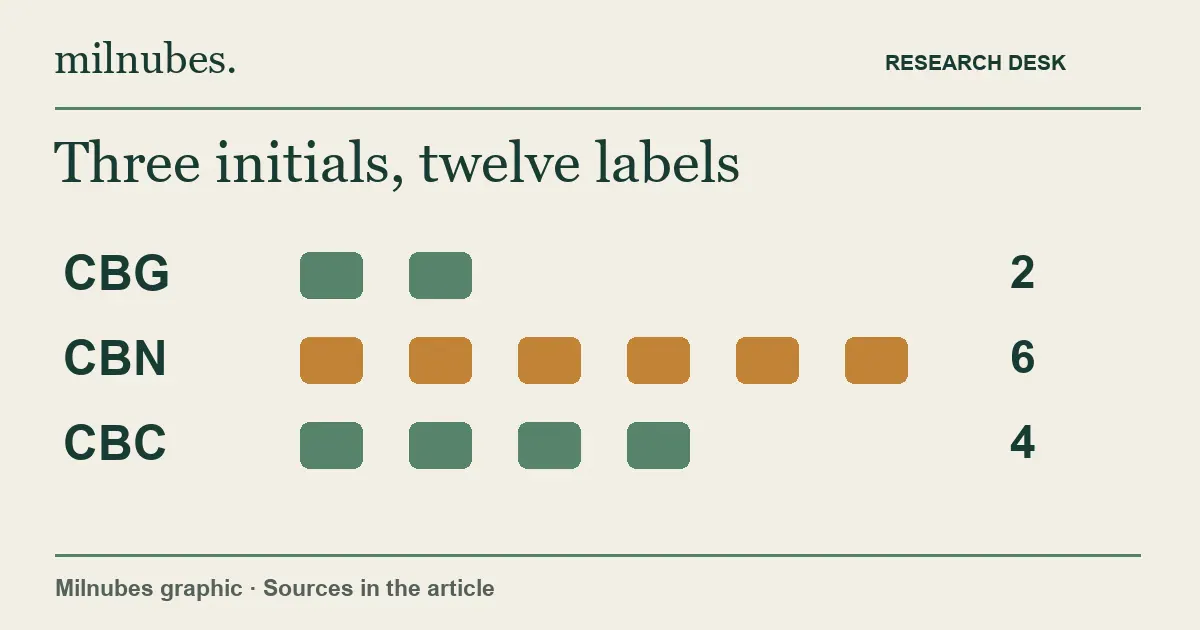
In CanaPuff’s English and Spanish public product sitemaps on 14 November 2026, we identified four liquids and eight individual vapes with CBG, CBN or CBC in the product name. The table groups flavours by format. Standalone cartridges and multi-item bundles are outside the count. The two language editions list the same twelve models.
What Blackjack Gelato and Wedding Cake have in common
These are the two bottled CBG liquids. The Blackjack Gelato description identifies cannabigerol and mentions terpenes. The two bottled CBN liquids are Papaya Punch and Watermelon. CanaPuff’s Papaya Punch description identifies cannabinol and terpenes. Official product image captions give 10 ml and 1,500 mg for each of the four bottles. Those figures amount to a nominal 150 mg/ml for the cannabinoid named on each bottle.
Why the percentage raises a different question
The four CBN devices state 89% and the four CBC devices state 79%. Both groups list a 1 ml reservoir. Converting a percentage to milligrams would require the basis of that percentage. If it is a mass fraction, we would also need the mass or density of the liquid. The reservoir volume alone cannot supply the missing figure. Measuring the aerosol would require a different sample altogether.
Matching the evidence to the sample
NIST identifies cannabigerol, cannabinol and cannabichromene as distinct compounds. Its reference material report characterises a sample of hemp plant. To check a particular bottle you would want a laboratory report identifying its batch, the liquid tested and the units of the result. CanaPuff says it offers batch reports on request. For this comparison we reviewed public documents. We did not examine batch reports for these twelve items or test any samples.
The limits of a catalogue comparison
An English or Spanish listing documents how a product is described in that catalogue. Assessing retail legality in a particular country would require the complete formulation, the product category and that market’s rules. A flavour name also tells us little about effects, safety or actual exposure. Those questions require evidence beyond the label.
Sources
- CanaPuff · English sitemap with product image titles and captions
- CanaPuff · Spanish public product sitemap
- CanaPuff · policy on batch analysis reports
- NIST · cannabinoid identification in the RM 8210 hemp reference material
- Spain’s Official State Gazette · consolidated decree and psychotropic schedules